
Plasma Transferred Arc
The PTA (Plasma Transferred Arc) process is an advanced technique for welding wear-resistant or corrosion-resistant coatings onto metal surfaces. It is particularly suitable for applications where extremely strong adhesion is required, such as in the oil and gas sector, or for intensively used machine parts.
Thanks to 20 years of experience in automatic PTA welding, Plasmajet has the necessary expertise and equipment to handle even the most demanding assignments.
How Does the Process Work?
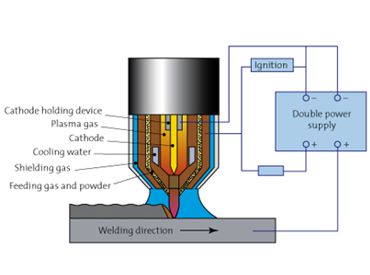
In PTA, a plasma arc is drawn between an electrode and the workpiece surface. At the same time, a metallic powder is blown into the molten pool, while the whole process is shielded from the ambient air by an inert gas.
This technique makes it possible to control critical welding parameters very accurately, such as:
- Gas flow
- Amperage and voltage
- Powder dosing rate
- Heat input
This allows welds of consistent quality to be achieved, with a mixing ratio of only 5 to 7%.
Features
Stronger metallurgical bond than with laser cladding
Thicker layers possible in a single operation
Fewer oxides and impurities in the weld layer
Better corrosion resistance and wear resistance compared to TIG or oxyacetylene welding


Typical applications
- Valves and seats for high-pressure systems
- Wear-resistant rings and sleeve bushings
- Corrosion-resistant coatings in chemical plants
- Repairs of heavily used machine parts
Typical materials
- Stellite 6 and other cobalt-based alloys
- Tungsten carbides in matrix
Capabilities at Plasmajet
Thanks to recent developments, Plasmajet can also weld internal bores from a diameter of 75 mm to a depth of 1200 mm.
Need a wear-resistant solution too?
We are happy to work with you to find the most suitable hardfacing solution.


