
Thermal spraying
Thermal spray coatings (TSC) is a collective term for techniques in which a wear-resistant or corrosion-resistant layer is applied to a component using a molten or heated particle stream.
Thanks to the relatively low substrate temperature (50–200°C), this is a so-called cold process—meaning that there is no deformation, structural change, or mixing of the base material. Ideal for repairing or improving fragile or precision parts.
How does thermal spraying work?
In thermal spraying, coating materials (powder or wire) are melted or heated in a spray gun, after which they are sprayed onto the surface of a component at high speed. Once cooled, the particles form a wear-resistant, well-adhering layer.
Plasmajet offers multiple thermal spraying processes, each with its own area of application and material types.


Plasma spraying
Characteristic: Very high temperature
Types of coatings: Ceramic coatings (oxide, Al₂O₃, ZrO₂…)

High Velocity Oxygen Fuel (=HVOF)
Feature: High speed & density
Type coatings: Wolframcarbide, chroomcarbide

Arc Spraying
Feature: Large surfaces, simple
Types of coatings: Zinc, aluminum, steel
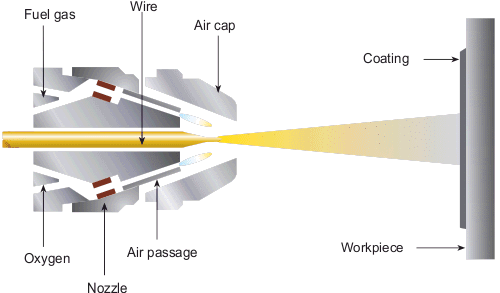
Flame spraying
Feature: Simple & flexible
Types of coatings: Zinc, copper, bronze, steel
Coatings can be customized based on desired properties:
- Abrasion resistance
- Corrosion protection
- Thermal insulation
- Electrical insulation or conduction

Capabilities
Plasmajet has its own machinery, which we use to:
- Parts up to 10 meters in length
- Diameter up to 2,500 mm
- Weight up to 10,000 kg
can treat and, if necessary, also pre-process and post-process (e.g., blasting, grinding).
Typical applications
- Repair of wear zones on shafts, cylinders, rollers
- Coatings for heat or corrosion protection
- Increasing the service life of intensively used machine parts
- OEM coating for new components
Customized advice?
Are you unsure which spraying process is suitable for your application? Our technicians will be happy to advise you.


